Leash Training a Cavalier King Charles Spaniel: Pulling, Lunging and Loose-Leash Walking
General training information. Every dog is an individual; for health or behavior concerns, see your veterinarian.
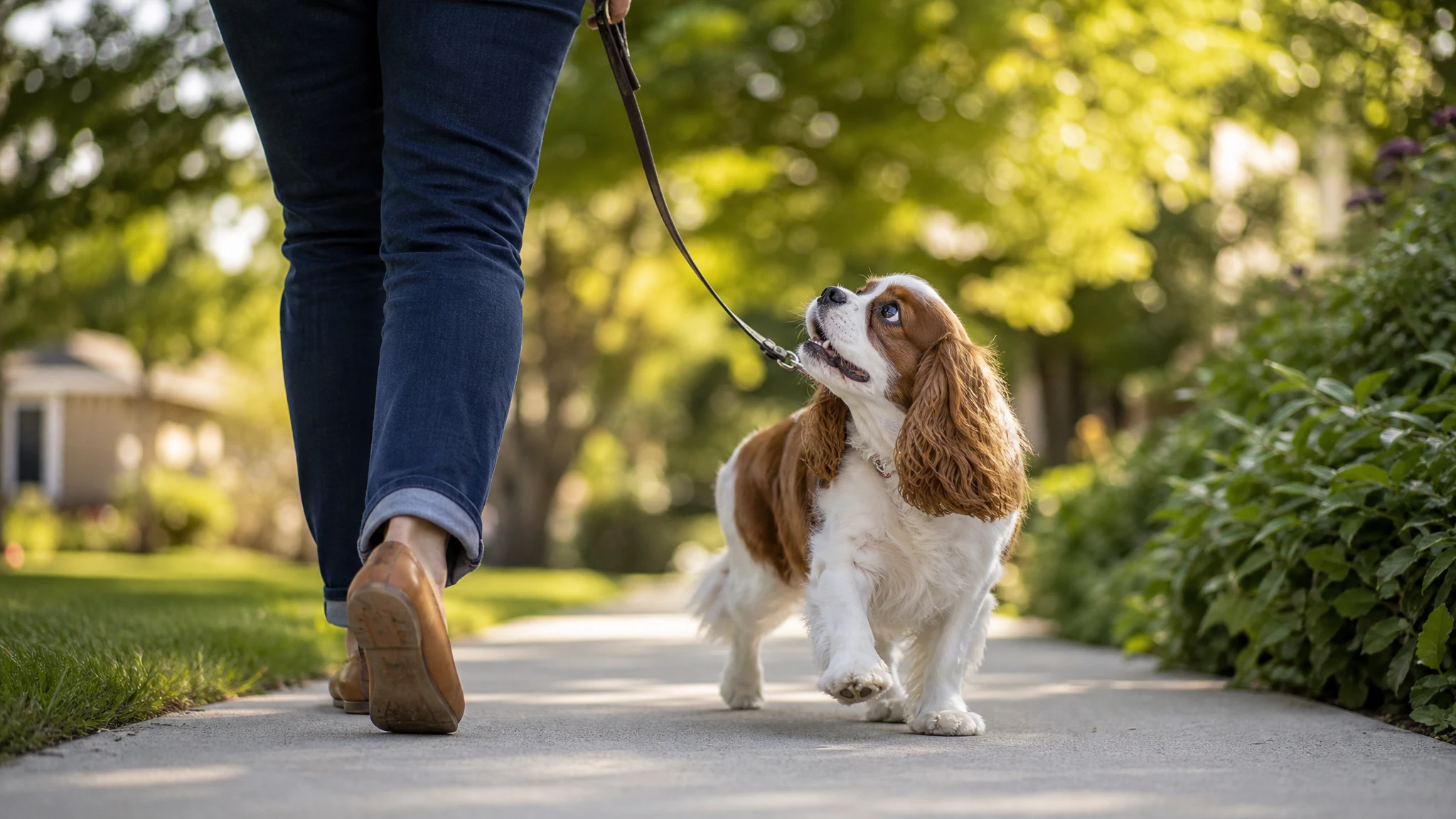
A Cavalier on a leash can look like a tiny sled dog. The tail is wagging, the nose is down, and the whole dog is leaning into the collar toward the next interesting smell or friendly stranger.
This guide covers cavalier king charles spaniel leash training from the first indoor lesson to walking past distractions. It also explains how to handle a Cavalier who lunges at dogs, people or bikes. Everything here is humane and reward-based, in line with the American Veterinary Society of Animal Behavior (AVSAB).
If you are building a wider training plan, start with our complete Cavalier King Charles Spaniel training guide. Then come back here for the walking skills.
Why a Cavalier pulls on the leash
Many people assume a spaniel pulls because of a hunting or herding drive. That does not fit this breed. The American Cavalier King Charles Spaniel Club (the AKC parent club) describes the breed's history as companion and lap warmer to the aristocracy, the "Comforter Spaniel." Its history page does not list hunting as an original purpose.
So what is going on when a Cavalier pulls? In most cases it is plain and fixable:
- Pulling works. Every time the leash goes tight and the dog gets closer to the smell, the squirrel or the neighbor, the pulling is rewarded.
- Excitement. The Cavalier Club, USA describes the breed as affectionate, playful and active. Walks are exciting.
- Your pace is slow. A small dog on a human stroll is working to keep up or get ahead.
- Unspent energy. The Westminster Kennel Club rates the breed's energy at 3 out of 5. The Cavalier Club, USA says these dogs need regular exercise, and PetMD suggests two walks of 20 to 30 minutes a day. Orvis notes that leisurely walks alone may not be quite enough.
The good news is trainability. The Westminster Kennel Club rates it 4 out of 5 and describes the breed as eager to please. Orvis does add that Cavaliers can be stubborn, so expect some days where your dog seems to forget everything. Individual dogs vary.
Materials you need
- A flat collar with an ID tag, or a well-fitted front-clip harness. Many owners of small dogs like a harness because it spreads pressure across the chest instead of the neck. If you have any worry about your dog's neck, windpipe or heart, ask your veterinarian which option suits your dog. PetMD and Orvis both note that the breed is prone to heart disease, which is a question for your vet and not something to guess at.
- A 4 to 6 foot standard leash. Skip retractable leashes while training. They teach the dog that pulling extends the leash.
- Small, soft, high-value treats that can be swallowed quickly. Pea-sized pieces are plenty for a dog this size. Count them as part of the daily food, and ask your vet about portions if weight is a concern.
- A treat pouch or a pocket you can reach fast.
- A quiet starting space such as a hallway, living room or fenced yard.
What not to use: prong collars, choke collars and shock collars. They work by causing discomfort, and AVSAB advises against aversive tools because they can increase fear and stress. They are not needed for a breed this eager to learn.
How to leash train a Cavalier King Charles Spaniel: step by step
Keep sessions short and fun. PetMD notes that positive reinforcement and short sessions work well for the breed. Five minutes, a few times a day, is a good target.
Step 1: Make the gear a good thing
Show the collar or harness, give a treat, then put it on. Repeat for a few days. Clip on the leash and let your dog wander indoors with it for a minute or two, feeding treats as they go. The goal is a dog who gets excited when the gear comes out, not one who dodges it.
Step 2: Teach "find your spot" indoors
Pick a side, left or right, and stay consistent. Stand still, hold a treat at your hip, and wait. When your dog steps into position at your side, say "yes" and deliver the treat right at your leg. Repeat until your dog hurries to that spot on their own.
Why at your leg? Whatever you reward is what you get more of. Treats delivered in front of you invite the dog to forge ahead.
Step 3: Add one step, then two
Take one step. If your dog stays at your side with a slack leash, mark and reward. Then two steps, then four. Change direction often so your dog learns to watch you. Keep the leash hanging in a loose "J" shape. If you notice the leash tightening, stop, and use the next step.
Step 4: Teach the "stop and wait" rule
This is the heart of loose-leash walking. The rule is simple: tight leash means the walk pauses, slack leash means it continues.
- The moment the leash goes tight, stop moving. Do not yank or scold.
- Stay calm and wait. Many dogs glance back within a few seconds.
- When the leash slackens or your dog looks at you, say "yes," reward at your leg, and walk on.
If your dog keeps leaning, turn and walk the other way. Reward the moment they catch up beside you. This takes patience, and every person in the family needs to follow the same rule. Even one "just this once" tug-along during a walk can slow progress.
Step 5: Move to the yard, then the street
Practice in a place with mild distractions first, like your driveway. Once your dog does well there, try a quiet street. Expect to be less successful at first because everything outside is more interesting than your treats. Go back a step in difficulty any time your dog stops responding.
Step 6: Give your dog a way to sniff
Sniffing is a real need, not misbehavior. Teach a release cue such as "go sniff." Walk on a loose leash for a stretch, then cue the release and let your dog explore the next patch of grass. Pulling then stops being the way to get to smells, because there is a polite way to ask.
Loose-leash games to practice
Games keep training light, which suits a playful breed.
- Penny game. Hold a handful of treats and drop one at your side every few steps while your dog walks beside you. The dog learns that being near you pays well.
- Direction roulette. Walk, then suddenly turn in a new direction with a cheerful voice. Reward your dog for catching up. This builds attention.
- Red light, green light. Stop on a tight leash, go on a slack one. Short bursts of fast walking can be a fun "green light" reward.
- Hand target. Teach your dog to touch your open hand with their nose. Use it to move past tempting spots by asking for a touch and a treat.
- Check-in game. Each time your dog looks at you on their own, mark and reward. Soon the look becomes a habit.
What to do about lunging
Lunging is different from steady pulling. It is a sudden burst toward or away from something, such as another dog, a person, a bicycle or a skateboard. The reason matters, because the fix depends on it.
Many Cavaliers lunge out of friendly excitement. The Westminster Kennel Club rates the breed 5 out of 5 for getting along with children and other dogs, and the Cavalier Club, USA says they do well with children, cats and other dogs. A dog who loves everyone may lunge simply because they want to say hello. Still, some dogs lunge from fear or frustration, and individual dogs vary. If you see growling, stiff posture or signs of fear, bring in a qualified, reward-based trainer or your veterinarian.
A simple plan for lunging at triggers
- Find your dog's threshold. This is the distance at which your dog notices the trigger but can still take a treat and respond to you.
- Stay under it. Cross the street or move aside before your dog reaches the point of lunging.
- Reward calm noticing. The moment your dog sees the trigger and stays relaxed, say "yes" and feed a few treats in a row.
- Turn away if needed. If your dog tenses, use a cheerful "let's go" and walk the other way. Reward them for following.
- Close the distance slowly. Over many sessions, move a little closer only when your dog is staying relaxed.
- Do not allow greeting on a tight leash. Say hello only when the leash is slack and the other owner agrees. A friendly dog who is allowed to greet by pulling learns that pulling works.
Do not punish lunging with leash jerks or scolding. That can make your dog link the trigger with something unpleasant and make the problem worse.
Tips for success
- Exercise first. A dog who has had a play session or a sniffy warm-up walk is more likely to think. This matters for a breed with regular exercise needs.
- Use real food. Kibble may not compete with a park full of smells. Use something your dog loves.
- Keep your voice upbeat. Cavaliers are described as affectionate and people-focused. Your attention is a powerful reward.
- Train before meals or pair it with part of the daily food. This keeps calories in check.
- Do not skip the home practice. Skills build faster in easy places.
- Be mindful of weather and effort. If your dog seems tired, panting hard or reluctant, rest. Ask your veterinarian about exercise limits, especially because the breed is described as prone to heart disease.
Common mistakes to avoid
- Letting the dog pull "sometimes." Mixed messages keep the habit alive.
- Yanking the leash. It can hurt the neck of a small dog and teaches nothing helpful.
- Using a retractable leash for training. It rewards pulling by design.
- Going too fast. Jumping to busy sidewalks before the basics are solid sets you up to fail.
- Treating a Cavalier as "too cute to train." Orvis notes the breed can be stubborn, so skills need steady practice.
- Leaving training to the dog's age. Puppies, adolescents and adults can all learn. Start with where your dog is now.
- Ending on a bad note. Finish each session with an easy win and a reward.
What results to expect
Timelines vary a lot. Age, past habits, the number of distractions and how consistent the household is all play a part. With regular, short practice, many dogs begin to walk more calmly at your side within a few weeks in easy places. Busy areas often take longer. Some dogs may need months before loose-leash walking feels reliable around big distractions.
You may see progress in small signs first: more check-ins, a faster response to a stop, or a slack leash for a few extra steps. Setbacks are normal, especially during adolescence or when something new is out on the street. This breed is described as eager to please, which can help, but no method works the same way for every dog.
If pulling or lunging is not improving, or if your dog seems anxious or in pain, talk with your veterinarian and consider a qualified trainer who uses reward-based methods.