Cavalier King Charles Spaniel Training: The Complete Guide for Owners
General training information. Every dog is an individual; for health or behavior concerns, see your veterinarian.
Cavalier King Charles Spaniel training is a pleasure for most owners and a surprise for a few. The breed is gentle, eager and quick to learn. It is also a dog that wants to be next to you at all times, and that single fact shapes almost everything about how to train one.
This guide explains what the breed was developed for, how that history points toward certain training choices, and how to move from puppy basics to a well-mannered adult. It also covers motivation, exercise, mental work and the problems worth planning for before they show up. If you want to know how to train a Cavalier King Charles Spaniel, start with the dog's purpose, then build around it.
One note on sources. Individual dogs vary a great deal, and the ratings quoted here are general descriptions of the breed, not promises about your dog. Where a source is secondary, the text says so.
Table of Contents
- Key takeaways
- What the breed was made for, and why it matters
- Training stages from puppy to adult
- Motivation that works for this breed
- Exercise and mental work
- Challenges to plan for
- A simple weekly training plan
- Sources
Key Takeaways
- The American Cavalier King Charles Spaniel Club describes the breed's history as that of a companion and lap warmer, not a hunting or working dog. Train for connection, not for a job.
- PetMD describes the breed as eager to please and easy to train, with positive reinforcement and short, fun sessions working well.
- Orvis notes the breed can be stubborn and slow to housebreak. Expect to be patient and consistent.
- PetMD says Cavaliers need human company and should not be left alone for long periods. Plan alone-time practice early.
- Regular exercise matters. The Cavalier King Charles Spaniel Club, USA calls them active and sporting little dogs that need it.
- Orvis says the breed is prone to heart disease. Health questions belong with your veterinarian, not in a training plan.
- Use only humane, reward-based methods, in line with the American Veterinary Society of Animal Behavior (AVSAB).
What the Breed Was Made For, and Why It Matters
Training goes better when you understand what a dog was shaped to do. Many breeds were built to herd, retrieve or guard. The Cavalier was not.
A companion first
The American Cavalier King Charles Spaniel Club, the AKC parent club, traces the breed to small toy spaniels favored at European and British courts. They were companions and lap warmers to the aristocracy, sometimes called the Comforter Spaniel. The club's history does not describe hunting as an original purpose.
The modern Cavalier was revived in the 1920s after Roswell Eldridge offered a prize at Crufts for the old type of dog, and a standard was drafted in 1928. The same club says the breed first arrived in the United States in 1952 and became the 140th AKC recognized breed on January 1, 1996.
Why does this matter for training? A dog bred to sit near people and be good company tends to look to people for everything. That is a gift when you teach name recognition, recall and polite greetings. It is a challenge when you need the dog to be comfortable alone.
Temperament in the sources
The Cavalier King Charles Spaniel Club, USA describes the breed as a delightfully affectionate, playful and intelligent little dog that is active and sporting. It says they get along well with children, cats and other dogs. The United Kennel Club standard describes the breed as gentle and affectionate, with no tendency toward nervousness.
The Westminster Kennel Club breed profile, a secondary source, gives the breed 4 out of 5 for trainability and describes it as eager to please and learn. It also gives 5 out of 5 for good with children and good with other dogs, 3 out of 5 for energy, and 3 out of 5 for barking. Treat these as a general picture. A shy Cavalier or a noisy one is still a Cavalier.
Size and what it means for handling
The United Kennel Club standard lists a height of 12 to 13 inches at the withers and a weight averaging 12 to 18 pounds, in proportion to height. PetMD gives 13 to 18 pounds for adults. A small dog is easy to lift, and that is exactly the trap. Dogs that get carried through every hard moment never learn to walk through it. Let your Cavalier use their own feet whenever it is safe.
Training Stages From Puppy to Adult
Reliable growth milestones for this breed are not published in the sources used here, so this section is organized by what you are teaching, not by exact ages. Your veterinarian can tell you when your puppy is cleared for outings, classes and other dogs.
Stage 1: The first weeks home
Your first goals are simple. Teach your puppy where to go to the bathroom, where to sleep, and that people are safe and rewarding.
- Bathroom routine. Take your puppy out after waking, after meals, after play and often in between. Reward right where they go, within a few seconds.
- Feeding schedule. PetMD recommends growth-labeled puppy food and feeding puppies three to four times a day to prevent low blood sugar. A set meal schedule also makes bathroom timing easier to predict. Ask your veterinarian about the right food and amounts.
- Name and eye contact. Say the name, mark the moment the puppy looks at you, and give a small treat.
- Handling. Gently touch paws, ears and mouth, then reward. A spaniel with long ears and a silky coat will need grooming and vet exams all their life.
Orvis says the breed can be slow to housebreak. If accidents continue, do not scold. Go back to more frequent trips, closer supervision and clean-up with an enzymatic cleaner so the spot does not smell like a toilet. If housetraining stalls for a long time, ask your veterinarian to rule out a medical cause.
Stage 2: Foundations and socialization
Once your veterinarian says it is safe, expand your puppy's world. Aim for calm, pleasant exposure to people, surfaces, sounds, car rides and well-mannered dogs. Quality matters more than quantity. One relaxed visit beats five overwhelming ones.
The sources describe the breed as friendly, so it is tempting to assume socialization is automatic. It is not. A friendly dog that has never met a bicycle, a vacuum or a hat can still be startled by one. Pair every new thing with food and let the puppy move away if they want to.
Core skills to teach in this stage:
- Sit, down and a settle on a mat
- Come when called, practiced indoors first
- Leave it and drop it, taught as trades
- Walking beside you on a loose leash
- Crate or pen comfort, with the door open at first
Stage 3: Adolescence
Many dogs go through a stretch where earlier training seems to vanish. Distractions get bigger, attention gets shorter and the "stubborn" label from Orvis starts to make sense. This is normal learning behavior, not defiance.
Do not abandon your plan. Go back a step, shorten sessions, use better rewards and ask for easier things in harder places. Keep recall on a long line in open spaces. A friendly, curious spaniel who bolts toward a stranger or another dog is a safety problem, not a cute moment.
Stage 4: The adult dog
PetMD, citing the AKC, gives a life expectancy of 12 to 15 years. That is a long time to enjoy a trained companion. Adult training is about maintenance and enrichment. Keep practicing the basics in new places, add new tricks, and keep rewarding the behaviors you love. Behavior that never earns anything fades.
Adult dogs can learn too. If you adopted an older Cavalier, the same methods apply. Start with the basics, go slowly and let the dog show you what they already know.
Motivation That Works for This Breed
PetMD says positive reinforcement and short, fun sessions work well for the breed. Orvis says Cavaliers learn quickly when sessions feel like play. That fits the dog's history as a companion who is happiest engaged with a person.
Use more than one reward
Food is the easiest reward, but it is not the only one. Many Cavaliers also work for praise, a game, a chance to greet someone or a cuddle. Keep a menu of rewards and match the reward to the difficulty of the task.
- Everyday cues in the living room: small, soft treats or part of a meal.
- Harder tasks outside: higher-value food, a favorite toy or access to something the dog wants.
- Life rewards: sit before the door opens, wait before the bowl goes down, settle before the leash comes on.
Small dogs can gain weight quickly on training treats. Count treats as part of the daily food, and ask your veterinarian about a healthy weight for your dog.
Keep sessions short
Five minutes, a few times a day, beats one long session. End while your dog is still enjoying it. A short, happy finish makes the next session easier to start.
Reward-based, humane methods only
The AVSAB supports reward-based training and cautions against punishment-based approaches. This guide does not recommend shock collars, prong collars, choke collars, alpha rolls, scruffing or any dominance method. They add fear and conflict, and a gentle, affectionate dog has little need for either.
If your dog gets something wrong, ask what you made too hard. Then make it easier, reward the right answer and move on.
Marker words and timing
A marker is a short, consistent signal, such as the word "yes" or a click, that tells your dog the exact moment they did the right thing. Pair it with a treat many times before you use it for teaching. Good timing is the difference between a dog who understands and a dog who is guessing.
Exercise and Mental Work
A tired, content dog learns better. A bored one invents hobbies, and you may not like them.
How much exercise
The Cavalier King Charles Spaniel Club, USA says the breed is active and sporting and needs regular exercise. PetMD suggests two walks of 20 to 30 minutes each day. Orvis says leisurely walks alone are not quite enough. Together, the message is clear: do not treat this as a couch-only breed. Add play, sniffing time and short training games to the walk.
The Westminster profile rates energy at 3 out of 5, which is moderate. Your own dog may sit above or below that. Watch your dog, and ask your veterinarian how much activity is appropriate, especially given the breed's reported heart concerns.
Mental work counts
Ten minutes of thinking can tire a dog as well as a longer walk. Try:
- Scatter feeding a meal in the grass or on a snuffle mat
- Hiding treats around a room and cueing "find it"
- Teaching a new trick each week, such as spin, touch or go to bed
- Puzzle feeders, used with supervision
- Practicing manners in a new place, such as a patio or a friend's yard
Dog sports
The Westminster profile says the breed does well in obedience and agility. Orvis, on the other hand, says Cavaliers are mostly companion animals and not strong candidates for sporting dog training. Both can be true. Many dogs enjoy sports as a way to spend time with their person, even if they will never be a champion in the field.
If you are curious, look for a beginner class run with reward-based methods and ask the instructor to explain their approach before you sign up. For breed-specific information on activities, check with the American Cavalier King Charles Spaniel Club.
Challenges to Plan For
The breed is easy to love, which makes it easy to underestimate. These are the issues the sources point to, plus common-sense steps for each.
Separation and being alone
PetMD says Cavaliers need human company and should not be left alone for long periods. A dog bred for closeness may struggle when you leave. Start with very short absences while your dog is calm, and build slowly. Give something safe to chew, leave without a big goodbye, and return calmly.
If your dog panics, drools heavily, destroys things near doors or cannot settle when you go, do not push through it. Ask your veterinarian for help, and consider a certified behavior professional who uses reward-based methods. Also plan for midday care if your work hours are long.
Stubbornness and housetraining
Orvis says the breed can be stubborn and slow to housebreak. A "stubborn" Cavalier often has a reward problem or a clarity problem. Is the treat worth the effort? Is the cue clear? Is the setting too exciting? Fix those first.
For housetraining, a predictable schedule and quick rewards are the most useful tools. Consistency from every person in the house matters more than any single trick.
Barking
The Westminster profile rates barking at 3 out of 5, which is moderate. Reward quiet, calm behavior early, and teach a "go to your mat" for doorbell moments. If your dog barks out of boredom or loneliness, add exercise and enrichment before you blame the dog.
Pulling and leash manners
Small dogs pull as much as big ones, but the consequences are less obvious. A harness that fits well can be more comfortable than a collar for a dog that lunges. Stop moving when the leash tightens, then reward when it loosens and the dog returns to your side. It is slow, but it works through repetition.
Heart concerns and health
Orvis says the breed is prone to heart disease. Details of recommended health screens and the full list of common health issues vary by source, so check with your veterinarian, the American Cavalier King Charles Spaniel Club and the Cavalier King Charles Spaniel Club, USA, which each publish their own breed health guidance. A reputable breeder should be able to explain the health testing behind a litter.
For training, the takeaway is simple. If your dog tires unusually fast, coughs, or seems different during exercise, stop and call your veterinarian. Do not try to diagnose it yourself, and do not push through.
Too much love, too few rules
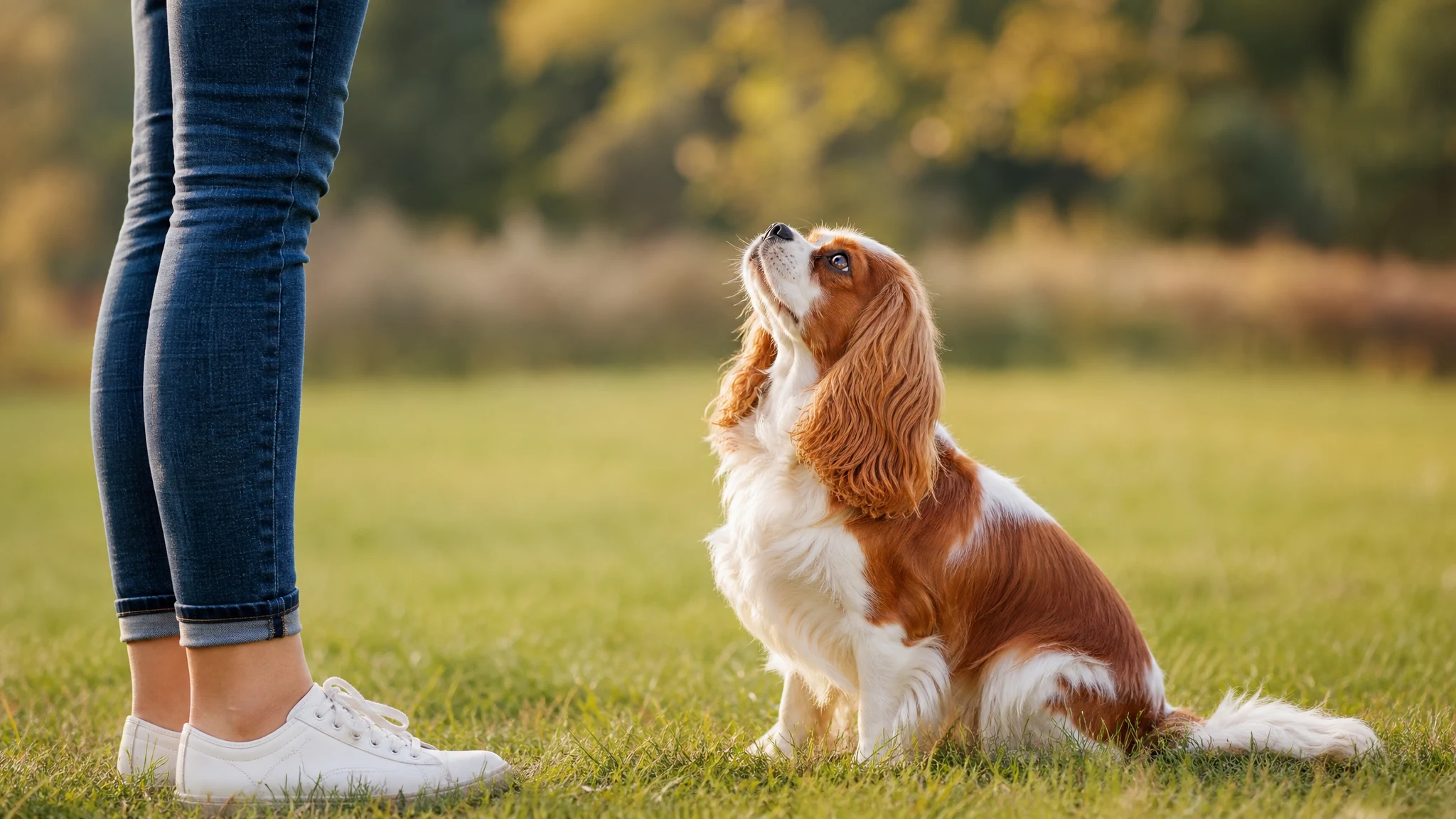
It is hard to say no to a face like this. But a dog who is allowed to jump, mouth and demand attention as a puppy will keep doing it as an adult. Pick a few household rules, share them with the family, and apply them every day.
Shedding and grooming as training
The Westminster profile rates shedding at 2 out of 5, and Orvis describes the breed as a moderate, seasonal shedder that is not hypoallergenic. Grooming is still a regular chore, and a calm dog makes it far easier. Teach your dog to stand or lie still for brushing, and reward cooperation with ears, feet and teeth. Short, happy sessions now save stress later.
A Simple Weekly Training Plan
Here is a flexible outline you can adapt. It is not a prescription, and your dog's age, health and temperament come first.
| Day | Focus | Time |
|---|---|---|
| Monday | Recall games indoors, then in a fenced yard | Two short sessions |
| Tuesday | Loose-leash walking and a sniff walk | One walk plus a 5 minute drill |
| Wednesday | Settle on a mat and alone-time practice | Short and calm |
| Thursday | New trick or scent game | Ten minutes |
| Friday | Manners in a new place | One outing |
| Saturday | Play, social time with a calm friend, grooming practice | Flexible |
| Sunday | Rest, easy walk, review favorites | Light |
Cavalier King Charles Spaniel training tips at a glance
- Keep sessions short and end on a win.
- Reward often, and vary the rewards.
- Practice being alone before it becomes a problem.
- Build in daily exercise plus mental work.
- Use a long line for recall practice outdoors.
- Be consistent as a household.
- Keep your veterinarian in the loop on health, weight and exercise.
- If you feel stuck, look for a trainer who uses reward-based methods and ask about their approach before you book.
Final Thoughts
Cavalier King Charles Spaniel training works best when you respect what the dog is: a companion bred for closeness, with a quick mind and a soft heart. Teach with rewards, keep it fun, plan for time alone, and give the dog enough exercise and thinking work. Expect some slow housetraining and a few stubborn days.
Most of all, enjoy the process. The bond you build while training is the best part of living with this breed.
Sources
- American Cavalier King Charles Spaniel Club: A Brief Breed History
- American Cavalier King Charles Spaniel Club (AKC parent club)
- Cavalier King Charles Spaniel Club, USA
- United Kennel Club: Cavalier King Charles Spaniel breed standard
- Westminster Kennel Club: Cavalier King Charles Spaniel breed profile
- PetMD: Cavalier King Charles Spaniel
- Orvis: Cavalier King Charles Spaniel