How Much Exercise Does a Cavalier King Charles Spaniel Need? Plus Brain Games
General training information. Every dog is an individual; for health or behavior concerns, see your veterinarian.
Cavaliers look like pure lap dogs, and they do love a lap. But a Cavalier who only gets a lap tends to get bored, and a bored Cavalier finds hobbies you will not enjoy.
This guide shows you how to build a simple daily routine that covers both body and brain. It also covers what to ask your veterinarian, because some details depend on the individual dog.
What You Need
- A well-fitted flat collar or a comfortable harness, plus a standard leash (no prong, choke or shock collars)
- Small, soft treats, or part of your dog's regular meal measured out as rewards
- A puzzle feeder or snuffle mat (a rolled towel or a muffin tin works for the homemade versions)
- A few cups or small boxes for hide-and-seek games
- A quiet room and about 10 minutes, a few times a day
- Water for walks, especially in warm weather
How Much Exercise Does a Cavalier King Charles Spaniel Need?
The Cavalier King Charles Spaniel Club, USA describes the breed as active and sporting little dogs that need regular exercise. So this is not a couch-only breed.
PetMD suggests two walks a day of 20 to 30 minutes each. Orvis adds that leisurely strolls alone are not quite enough for them. The Westminster Kennel Club rates the breed's energy level at 3 out of 5, which is moderate.
Put those together and a good starting point is two decent walks plus some play. Think of it as a baseline, not a rule. Individual dogs vary, so watch your own dog and adjust.
| Life stage | What the sources say | What to do |
|---|---|---|
| Puppy | PetMD does not give growth milestones or exercise limits. It does suggest feeding puppies three to four times a day to prevent low blood sugar. | Ask your veterinarian and your breeder how much activity suits your puppy's age. Keep sessions short and play gentle until you hear back. |
| Adult | Two daily walks of 20 to 30 minutes (PetMD), plus regular exercise (CKCSC, USA). | Use the routine below and adjust to your dog's energy and your vet's advice. |
| Senior | The sources I relied on give no senior-specific exercise guidance. | Ask your veterinarian. Shorter, more frequent walks and more sniffing are common sense, but let your vet set the limits. |
One more point on health. Orvis notes that the breed is prone to heart disease. I cannot tell you what that means for your dog, and neither can a walking guide. If your Cavalier tires quickly, coughs or seems off during exercise, stop and call your veterinarian. Ask for an exercise plan that fits your dog specifically.
Step 1: Set Up a Daily Walking Routine
Start with the baseline from PetMD: two walks a day, about 20 to 30 minutes each. Morning and late afternoon or evening works well for most households.
If your dog is new to you, a puppy, or out of shape, start shorter and build up over a couple of weeks. Slow builds are kinder to a body that is not used to the work.
Keep your dog on a leash in any area that is not securely fenced. Check your local leash rules with your city or county, since they vary.
Step 2: Turn One Walk Into a Sniff Walk
Walking fast is exercise for the legs. Sniffing is exercise for the brain. A sniff walk gives you both.
- Pick a route with grass, bushes, trees and interesting corners.
- Let your dog choose some of the stops. Stand patiently while they investigate.
- Set a rule for yourself: no tugging along just to hit a time target.
- Put a few "find it" moments in. Toss a treat into short grass and say "find it."
- End the walk with a calm minute of sniffing near home before going inside.
Many owners find a dog is more settled after a sniffy walk than after a brisk one of the same length. That is not a promise for every dog, but it is worth trying.
Step 3: Add Short Play Sessions
The American Cavalier King Charles Spaniel Club's breed history says the Cavalier was bred as a companion and lap warmer to the aristocracy, not as a working or hunting dog. That shapes how I think about play.
This is a dog bred for closeness with people. So the best games are ones you play together, not ones that send the dog off alone.
- Gentle fetch in a safe, enclosed area, 5 to 10 throws at a time
- Short tug with a soft toy, with a clear "drop it" cue that earns a treat
- Chase-me games in the yard or a hallway, where you run and your dog follows
Orvis describes the breed as mostly companion animals who are not strong candidates for sporting dog training. Westminster says they do well in obedience and agility. Those views differ, so treat sports as something to try for fun if your dog enjoys it, not as a goal.
Step 4: Build in Brain Games
Cavalier King Charles Spaniel mental stimulation does not need fancy gear. Westminster rates the breed's trainability at 4 out of 5 and calls it eager to please and learn. Orvis says they learn quickly when sessions feel like play. That makes training itself the best brain game.
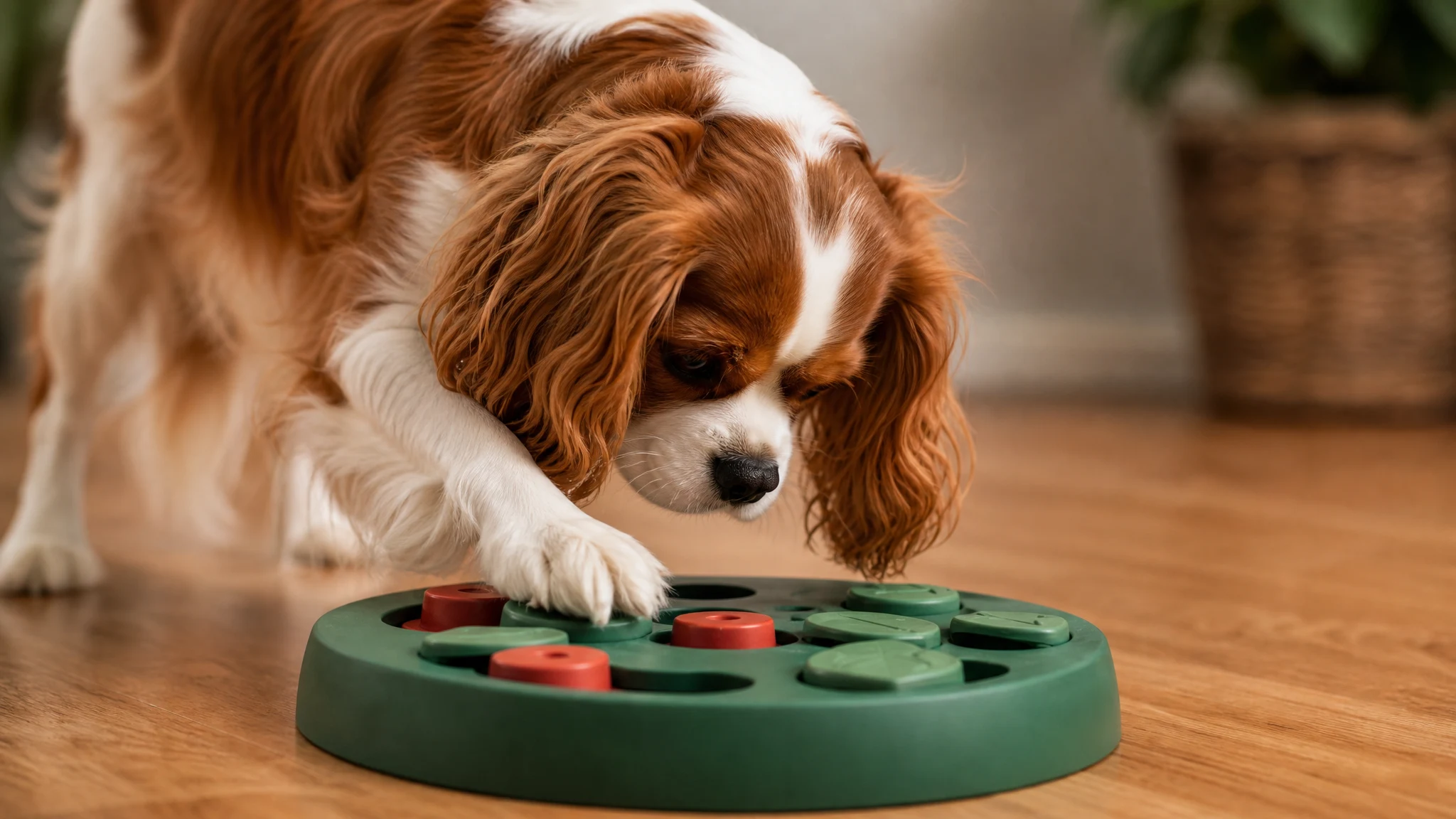
Game 1: The Puzzle Feeder Meal
Skip the bowl once a day. Put your dog's measured meal in a puzzle feeder or a snuffle mat, or scatter it across a towel and roll the towel up loosely.
Watch the first few tries. If your dog gets frustrated, make it easier. The goal is a fun challenge, not a fight.
Game 2: Find the Treat
- Show your dog a treat, then place it under one of three cups.
- Say "find it" and let your dog nose or paw the right cup.
- Reward right away when they pick the correct one.
- Once they have it down, shuffle the cups slowly and try again.
Game 3: Hide and Seek
This one suits a breed that likes being near its people. Ask your dog to stay, hide in the next room, then call their name. Make the first hiding spots easy, like behind a door. Celebrate when they find you.
Game 4: Learn a New Trick a Week
PetMD recommends positive reinforcement and short, fun sessions for this breed. Pick one simple skill at a time, such as spin, touch (nose to your hand), or go to your mat.
- Keep sessions to about 3 to 5 minutes.
- Reward the first small step toward the behavior.
- Gradually ask for a little more before rewarding.
- End on a success, even if it is an easy one.
For the bigger picture on manners and basics, see our complete Cavalier King Charles Spaniel training guide.
Step 5: Plan Your Dog's Week
A simple schedule keeps you honest. Here is one way to lay it out for a healthy adult, to be adjusted with your vet's guidance:
- Morning: 20 to 30 minute walk, with some sniff time
- Midday: puzzle feeder or a short training game
- Late afternoon: second walk or a play session
- Evening: a calm trick practice, then settle time with you
PetMD says the breed needs human company and should not be left alone for long periods. If your workday is long, a midday visit from a family member or a trusted pet sitter can help. Brain games can fill part of the gap, but they do not replace company.
Tips for Success
- Rotate the games. Novelty keeps a smart dog interested.
- Use real rewards. Small, soft treats work faster than dry kibble when there are distractions.
- Count treats as food. Take them out of the daily meal so your dog does not gain weight. Ask your vet about the right amount.
- Keep it positive. The American Veterinary Society of Animal Behavior supports reward-based training. If a game is not working, make it easier instead of pushing harder.
- Watch the weather. Be careful in hot weather. Bring water and shorten the walk if your dog seems tired.
Common Mistakes to Avoid
- Relying on the backyard. A yard does not give a Cavalier the structured activity or company that a walk and a game do.
- Making every walk a march. Constant pulling forward leaves no room for sniffing, and sniffing is the brain work.
- Skipping mental work on rainy days. Indoor puzzle games and trick practice can cover the gap.
- Overdoing it with a young puppy. The sources I used give no puppy exercise limits, so ask your vet and breeder rather than guessing.
- Ignoring warning signs. Given the breed's known heart concerns, unusual tiredness or coughing is a reason to call your veterinarian, not to push on.
- Leaving a stubborn streak unaddressed with force. Orvis says the breed can be stubborn and slow to housebreak. Patience and rewards work better than pressure.
What to Expect
With a steady routine, many owners find their Cavalier is calmer at home, more focused during training, and less likely to invent their own entertainment. Results vary by dog, age and health, and it may take a few weeks to see a pattern.
The breed is described as affectionate, playful and intelligent by the Cavalier King Charles Spaniel Club, USA. Exercise and games that include you play to those strengths.
If your dog's behavior or energy does not seem to match what you read here, talk with your veterinarian. They can rule out health reasons and help you set the right level of activity.